Doesn't time fly! It was a quarter of a century ago - in 1996- that my book, Bunyips and Bigfoots, in search of Australia's mystery animals was published. Since then, it appears to have become a boon to second-hand booksellers. From a recent websearch, I notice that the asking price varies from $50 to $220 US. At least that's lower than the £3000 (pounds, not dollars!) one seller was asking in late 2013. Even I admit that it wasn't worth that much. Never fear, however; I have just published an up-dated second edition at a reasonable price in both print-on-demand paperback and Kindle editions.
Showing posts with label book. Show all posts
Showing posts with label book. Show all posts
Friday, 5 February 2021


Monday, 17 August 2020
Forgotten Bigfoots Around the World - a New Book
Everyone has heard of the bigfoot, or sasquatch of North America, but it is not so well known that reports of similar beings exist in every continent except Antarctica. Ivan T. Sanderson did a fairly good job of summarising the evidence in his 1961 book, Abominable Snowmen: legend brought to life - though even he managed to miss the yowie of Australia, one continent where such animals definitely should not exist. Now I have published a new book on the subject - in both paperback and e-book editions, and available through Amazon - to provide information otherwise unavailable to the average Anglophone reader.
Friday, 20 March 2020
Introducing Three New Books
Wednesday, 1 May 2019
The Beast of Gévaudan - Solved !
Between 1764 and 1767 a huge man-eater terrorised the region surrounding the southern French town of Gévaudan, claiming between 80 and 100 lives. People, often teenagers, tended the fields bearing spears. A detachment of dragoons was sent to hunt the Beast, and. 10,000 citizens were engaged as a battue to flush it out. Several times its death was announced, but the killings kept going on. It took a number of musket balls at relatively close range. The Beast of Gévaudan has become the stuff of legend and speculation. What was it? Officially a wolf. Or perhaps some huge wolf-dog hybrid. Or a hyaena. Or even a werewolf, according to Montague Summers! But now, at last, a German zoologist, Karl-Hans Taake has examined the primary sources, and definitively identified it.
Tuesday, 2 June 2015
Journal of Cryptozoology, Volume 3

Saturday, 10 January 2015
"The Tasmanian Tiger: Extinct or Extant?" - a Review
Rebecca Lang (editor)(2014), The Tasmanian Tiger: Extinct or Extant?", Strange Nation Publishing, available from Amazon and other online booksellers.
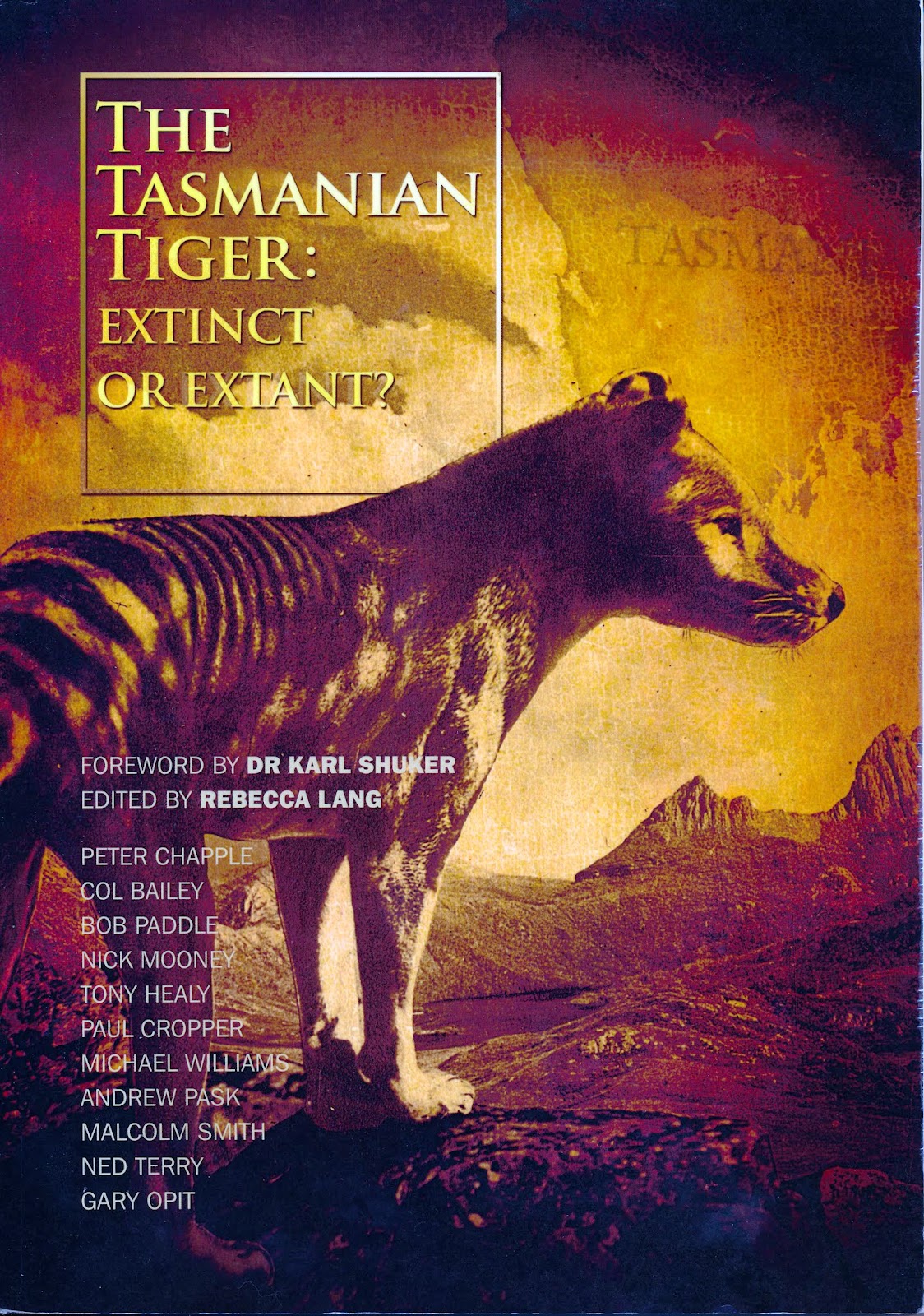 As I pointed out in an earlier post, the extinction of various bandicoots and wallabies, not to mention those species which are holding on to the edge of the precipice by their little claws, has failed to register on most Australians, but the loss of the Tasmanian tiger, or thylacine, has really touched a raw nerve.
Now, Rebecca Lang, co-author of Australian Big Cats and co-founder of Strange Nation Publishing, has assembled an array of contributors to express their opinion as to whether this iconic marsupial is now completely extinct, or whether it still clings to existence in some place or other.
And since it appears to have been taken for granted that I would end up writing a review, I suppose I had better make two things clear from the beginning:
First disclaimer: I am one of the contributors.
Second disclaimer: I know the editor and some of the contributors, and those I don't know I nevertheless respect. However, a reviewer should, ideally, attempt to be completely objective - indeed, brutally honest. That sounds like a good way to lose friends and make enemies, and I now understand how some professionals, working in a very limited field, end up getting an easy run through the peer review process. With all this in mind, let us continue.
Now, Rebecca Lang, co-author of Australian Big Cats and co-founder of Strange Nation Publishing, has assembled an array of contributors to express their opinion as to whether this iconic marsupial is now completely extinct, or whether it still clings to existence in some place or other.
And since it appears to have been taken for granted that I would end up writing a review, I suppose I had better make two things clear from the beginning:
First disclaimer: I am one of the contributors.
Second disclaimer: I know the editor and some of the contributors, and those I don't know I nevertheless respect. However, a reviewer should, ideally, attempt to be completely objective - indeed, brutally honest. That sounds like a good way to lose friends and make enemies, and I now understand how some professionals, working in a very limited field, end up getting an easy run through the peer review process. With all this in mind, let us continue.
Saturday, 1 March 2014
Journal of Cryptozoology, volume 2

In any case, it is clear that the journal is shaping up to solid professional standards, with four excellent papers covering 65 pages of text.
The first was entitled Three remarkable tales and two challenges for anthropology - an evaluation of recently reported eyewitness accounts of unidentified hominoids from Flores Island by Gregory Forth, a cultural anthropologist who has been studying the societies of the Indonesian island of Flores since 1984. In the process he became intrigued by the folklore concerning small, usually hairy "wildmen", first of all in Flores, then in the remainder of Indonesia, and finally in mainland southeast Asia itself. Here is a review of a recent book he wrote on the subject. Then, of course, in 2004 came the discovery of the fossil remains of the "hobbit", Homo floresiensis, a diminutive offshoot of the human family tree which could, theoretically, give rise to such legends, especially since there is disputed evidence that it may have survived until little more than 6,000 years ago.
Subscribe to:
Posts (Atom)